
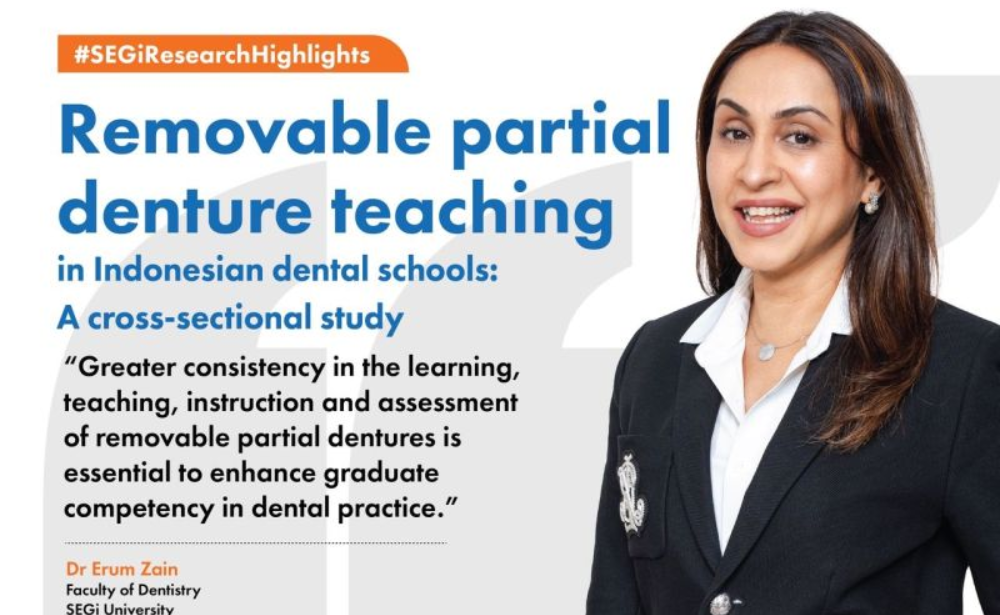
Removable partial dentures are more than a clinical requirement in dental education. They play an important role in preparing future dentists to restore oral function, patient confidence, and quality of life for individuals with missing teeth.
This important area of dental training is explored in a study contributed by Dr Erum Zain from the Faculty of Dentistry, titled “Removable Partial Denture Teaching in Indonesian Dental Schools: A Cross Sectional Study.” The paper examines how removable partial denture education is delivered across dental schools in Indonesia, providing valuable insights into existing teaching practices, clinical exposure, supervision, and assessment methods.
With an 84 per cent response rate, the study found that removable partial denture education is generally well integrated into dental curricula. However, it also revealed notable differences in how the subject is taught and assessed across institutions. These variations include teaching approaches, supervision models, clinical training opportunities, and expectations placed on students before graduation.
One of the key findings highlighted in the study is that nearly half of the dental schools surveyed require only minimal clinical cases before students graduate. This raises important questions about graduate readiness, particularly in managing real clinical situations that involve complex prosthodontic needs.
The paper also draws attention to the reliance on external laboratories in some dental schools. While external support may assist in technical production, it can also limit students’ hands on exposure to laboratory procedures. Such exposure is essential in building practical confidence, clinical judgement, and a deeper understanding of removable partial denture design and fabrication.
As the study emphasises, “Greater consistency in the learning, teaching, instruction and assessment of removable partial dentures is essential to enhance graduate competency in dental practice.”
This publication reinforces the need for stronger harmonisation in dental education, particularly in areas that directly influence clinical competence. By highlighting both strengths and areas for improvement, the study contributes meaningfully to ongoing conversations on how dental schools can better prepare future dentists for professional practice.
Ultimately, the research underscores the importance of equipping dental graduates not only with theoretical knowledge, but also with the practical skills and confidence needed to manage complex prosthodontic cases effectively.
Journal: Journal of Dentistry
Publisher: Springer
Collaborators: Preena Sidhu, Normaliza Ab Malik, Ratna Sari Dewi, Saraventi Mursid, Atik Ramadhani, Nairn H F Wilson, Christopher D. Lynch, Zeeshan Sheikh, Muneer Gohar Babar, Liang Lin Seow, Igor R. Blum, and Umer Daood.