
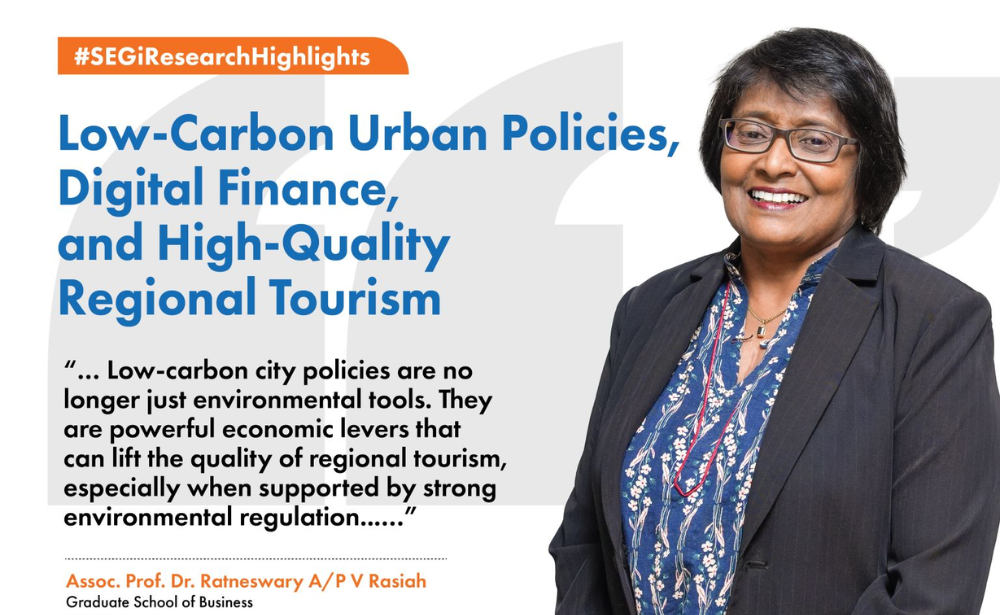
Sustainable tourism is no longer shaped by destination branding alone. It is increasingly influenced by how cities respond to environmental challenges and how financial systems evolve to support greener growth. In this study, Assoc. Prof. Dr. Ratneswary Rasiah, PhD from the Graduate School of Business explores how low carbon city policies contribute to the high quality development of regional tourism, while highlighting the important role of digital finance in strengthening this relationship.
Drawing on data from Chinese prefecture level cities from 2007 to 2023, the study examines the interaction between environmental governance and financial digitalisation in shaping tourism outcomes. The findings show that low carbon city policies significantly improve tourism quality, particularly in regions where environmental regulations are more stringent. This suggests that strong policy direction, when reinforced by a supportive regulatory environment, can create better conditions for sustainable tourism growth.
A key contribution of the research lies in its focus on digital finance as a mediating factor. The study finds that digital finance helps translate low carbon policies into stronger tourism performance by expanding access to financial resources and enabling the growth of green tourism initiatives. However, its influence is not uniform across all regions, with differences emerging according to levels of regional openness. This points to the need for more tailored policy approaches rather than a one size fits all strategy.
By integrating digital finance into the discussion on sustainable tourism development, the study extends existing research in a meaningful way while offering practical value for policymakers. Its findings provide timely guidance for those seeking to align environmental regulation with financial innovation in order to support more sustainable and high quality tourism development.
Published in: Finance Research Letters (SCOPUS Q1)
Publisher: Elsevier B.V.