
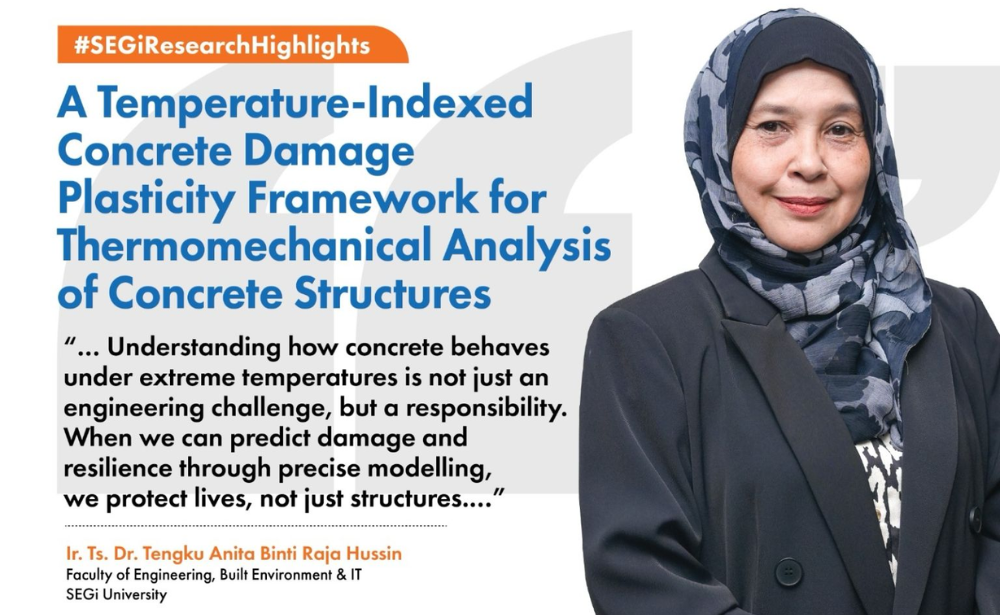
Thermomechanical Analysis of Concrete Structures
Understanding how concrete structures respond to extreme heat is essential for improving safety, structural reliability, and recovery planning after fire related incidents. In this study, Ir. Ts. Dr. Tengku Anita, P.Eng(PEPC), MIEM, MSSA, MBOT from the Faculty of Engineering, Built Environment and IT examines the behaviour of reinforced concrete when exposed to temperatures ranging from 20°C to 800°C under combined thermal and mechanical loading.
Through a combination of laboratory testing and advanced numerical modelling, the research captured how rising temperatures affect the stiffness, strength, and damage behaviour of reinforced concrete. The study offers important insight into the way concrete performance changes under severe thermal conditions, particularly when structural elements continue to carry loads while being exposed to heat.
A temperature indexed concrete damage plasticity model was developed and calibrated with high accuracy, achieving an R² value of approximately 0.94. The findings reveal that reinforced concrete undergoes rapid deterioration beyond 500°C to 600°C, with damage becoming more widespread and higher strains required as the material weakens. These results provide a clearer picture of how concrete structures degrade under extreme conditions and where critical thresholds begin to emerge.
The study makes a valuable contribution to the field of structural engineering by supporting more reliable assessments of concrete structures after fire exposure. It also offers practical guidance for engineers and decision makers involved in structural rehabilitation, helping to improve evaluation methods and recovery strategies for damaged buildings and infrastructure.
Published in: Journal of Engineering and Applied Science (Scopus 2)
Publisher: Springer Nature