
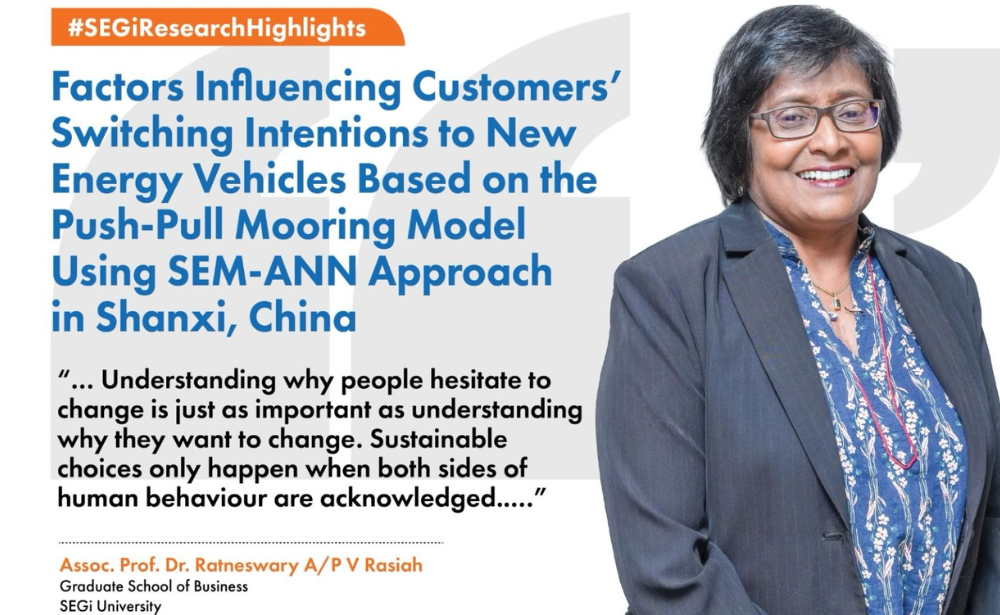
As the global push for cleaner transportation gains momentum, understanding why consumers move away from conventional vehicles has become increasingly important. In this study, Assoc. Prof. Dr. Ratneswary Rasiah, PhD from the Graduate School of Business explores the behavioural factors that influence customers to switch to new energy vehicles, offering timely insight into what drives or delays this transition.
Using the Push Pull Mooring model together with a SEM ANN hybrid analytical approach, the study draws on responses from 822 individuals in Shanxi, China. The research identifies several strong push factors that encourage consumers to leave traditional vehicles behind, including growing environmental concern and dissatisfaction with conventional vehicle options. At the same time, key pull factors such as perceived convenience, social influence, and the overall attractiveness of new energy vehicles make the shift more appealing.
However, the transition is not shaped by motivation alone. The study also finds that switching costs, habitual behaviour, and inertia continue to act as major barriers, preventing some consumers from making the change even when they recognise the potential benefits of new energy vehicles. These findings show that consumer decisions are influenced by both positive attraction and resistance to change, making the switch far more complex than a simple preference for greener alternatives.
By integrating the Push Pull Mooring framework with Status Quo Bias theory, the research presents a robust model for understanding consumer mobility decisions. It also provides valuable strategic insight for policymakers, industry players, and stakeholders seeking to accelerate low carbon transportation adoption, particularly in high emission regions where behaviour change is critical to long term sustainability goals.
Published in: Scientific Reports (SCOPUS Q1)
Publisher: Nature Research